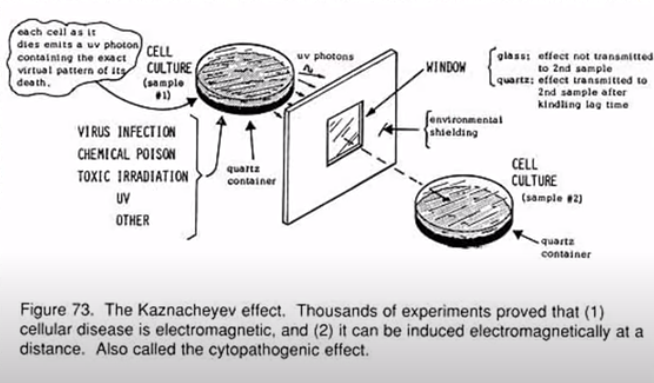
V.P. Kaznacheev performed experiments in which a diseased culture apparently caused a cytopathic effect in another healthy culture in a separate sealed container connected via a quartz window.
The effect was not observed with a glass window.

When cells in one culture died they emitted a small pulse of ultraviolet radiation which passed through the window and seemingly caused a cytopathic response in the formerly healthy culture.
For a more detailed summary, see here: ViroLIEgy
What really causes the effect?
The Spectroscopy of Vapor Phase Benzaldehyde and Distant Intercellular Interactions of Chick Embryo Fibroblast Cell Cultures. – Shirley
The author reproduced the cytopathic effect of Kaznacheev and also detected the emission of light from the diseased culture but disagreed that the ultra-violet photons were responsible for the transmission of the effect:
The mirror cytopathic effect reported by Kaznacheev was investigated to ascertain if light was emitted from chick embryo fibroblast tissue cultures after ultraviolet light radiation. The claim that these cells emit light after being irradiated by ultraviolet light was substantiated to our satisfaction. The mirror cytopathic effect was not. Other mechanisms for cell death in the cell colonies needs further investigation before Kaznacheev’s claim can be accepted.
The reason for this seeming anomaly and other inconsistencies in similar experiments involving bio-photons is explained by Konstantin Meyl in his book “Scalar waves: a first Tesla physics handbook“.
The claim is that both photons (transverse waves) and scalar waves (longitudinal waves or Tesla waves) are involved and whilst it is predominantly the photons that are measured, it is the scalar waves that have the biological effects.
Scalar waves can tunnel through some materials such as quartz but may be inhibited or modified by others. They are emitted as an unintentional artefact by some electronic equipment and are invariably unmonitored and undetected.
The degree of production of these waves may vary from one piece of equipment to another with the consequence that if all that is measured is the usual photon emission, then all effects are going to be attributed to such photons and there will be an apparently abnormal dose-response curve. A causal relationship has been assumed where none actually exists.
The emission of ultra-violet light from biological systems is similarly misleading as intra-cellular communication is, according to Meyl, largely a matter of scalar wave transmission, with the emission of photons being an unintended and largely irrelevant phenomenon.
Seasonal effects
Kaznacheev documented the strength of the effect over several years and several thousand experiments and found that it varied on a seasonal basis with the effect being at its weakest in the winter months.

Bacterial cultures form a collective bio-field within which a scalar wave network is used to communicate information. Such signals are unmeasurable with current technology but their effects are apparent.
Thus an effective field-receptive antenna is formed that is open to the elements and is sensitive to scalar wave input from:
- Seasonal variations in the Earth’s magnetic field
- Ambient EMF from cell-phones, dirty electricity etc..
- Other cell cultures within the laboratory
- The laboratory technicians themselves
Shedding
The mechanism described here is very likely the same mechanism responsible for the phenomenon of vaccine shedding: Vaccine shedding
Implications for virology
The cytopathic effect has been used historically to determine the presence of viral particles within a tissue culture but the above suggests that there are other unseen factors that may reliably produce a similar effect.
Some sort of control experiment is often performed but what is the point if we don’t even know what factors we are supposed to be controlling?
Often it will be found that a control sample itself displays the cytopathic effect. This is invariably explained away as ‘contamination’ of the sample by the virus. However, this is highly circular reasoning, as it is precisely these experiments that are being used to determine the presence of a virus in the first place.
If we knew that the cytopathic effect necessarily implied the existence of viral particles then we wouldn’t need a control sample!
Variations on a similar theme have been performed by many different scientists. For example:
” Thus the response of cultured, mammalian cells to near-infrared light signals is not merely a matter of total energy absorption by certain cytoplasmic components. Since it seems to depend on the cell type and the temporal pattern in which the light energy is emitted, it appears to imply the existence of a new kind of cellular information.” – Gunter Albrecht-Buhler

Cells do not simply transmit an on/off ‘death’ signal but can also communicate their physical orientation:
“After 7 hr of attaching and spreading in the absence of visible light, most of the cells on the s-face traversed with their long axes the direction of the whorls of the confluent cells on the c-face directly opposed. The effect was inhibited by a thin metal coating of the glass films. The results suggest that the cells were able to detect the orientation of others by signals that penetrated glass but not thin metallic films and, therefore, appeared to be carried by electromagnetic radiation. In contrast, the effect was not influenced by a thin coat of silicone on the glass, suggesting that the wavelength of this radiation is likely to be in the red to infrared range. The ability of cells to detect the direction of others by electromagnetic signals points to a rudimentary form of cellular vision.” – Albrecht-Buhler
This sounds like too much information for simple photons to transmit and we should therefore suspect some kind of scalar wave transmission as above.
Mely has said simply that within biological systems “Information is the structure of scalar wave“. Such waves are likely the vehicle for ‘genetic’ information (Evolution and Inheritance), and the existence of fractal vortices allows for an arbitrary amount of information to be transmitted in a tiny volume of space: Vortices in cosmology and biology
Related pages:

References
Distant intercellular electromagnetic interaction between two tissue cultures – Kaznacheev
Distant intercellular electromagnetic interaction between two tissue cultures
Extraordinary Biology
http://www.cheniere.org/books/aids/ch5.htm
Quantum: May be a new-found messenger in biological systems – Han, Yang Chen
https://www.biosciencetrends.com/downloadpdf/429
Electromagnetic cellular interactions – Cifra, Fields, Farhadi
https://pubmed.ncbi.nlm.nih.gov/20674588/
Albrecht-Buehler G. Changes of cell behaviour by near-infrared signals.
https://pubmed.ncbi.nlm.nih.gov/8608608/
Rudimentary form of cellular “vision” – Albrecht-Buehler G.
https://www.ncbi.nlm.nih.gov/pmc/articles/PMC49903/pdf/pnas01091-0448.pdf
Non-Chemical Distant Cellular Interactions as a potential confounder of cell biology experiments – Ashkan Farhadi
https://www.ncbi.nlm.nih.gov/pmc/articles/PMC4201089/